

Folklore · 9 minute read
Duel With Song
Preserved from the castle’s former website as a work of folklore. Dates, people and events in this story do not establish the documented chronology of Belvelly Castle.
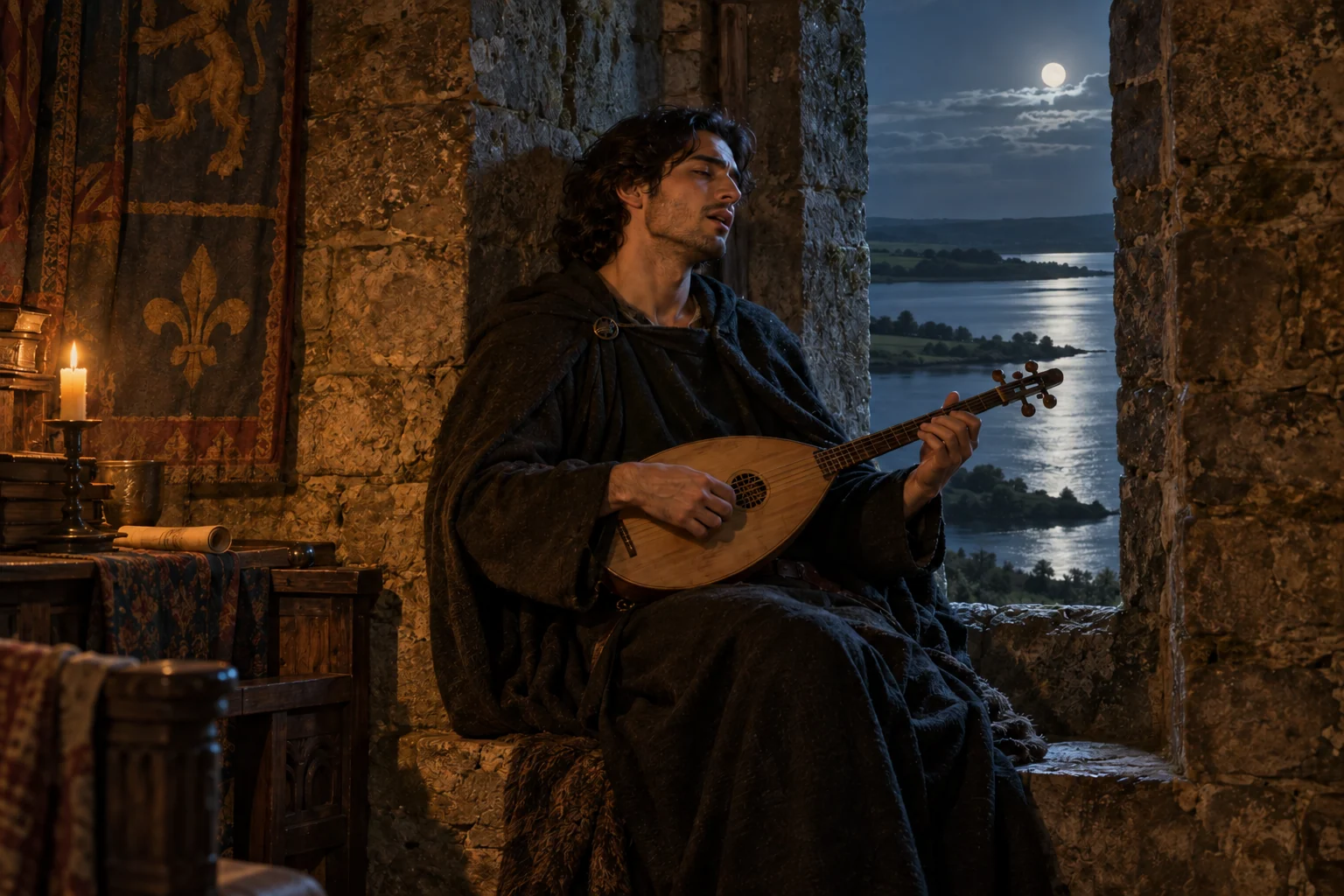
In the year 1209, according to Caley’s account of the story, a Spanish galleon was seen to be in great distress off Ballycotton Light, as the spot is known today. Beyond doubt there was a lighthouse of sorts in that early day, for it is a devious point of rock, and Cobh Harbour is just round the bend. Wallowing in a gigantic sea, the ship soon foundered. Among the handful of survivers was a handsome Spanish youth who clutched a tamboura wrapped up in a cloak. His beautiful voice, accompanied by the haunting music that he played on this instrument, soon established Luccero Moreno in the big stone houses of Cobh. A troubadour had never been seen in the south of Ireland. Galway claimed a few of Spanish & Moorish breed who had come on trading ships, but as far as is known, they soon returned to there native lands.
Irish bards were the singer-poets, sometimes itinerant, but often gifted and learned men. In the constant patronage of a king or chieftain, they were well known to the four extremities of Ireland. It was not long before an historic meeting took place between Ireland’s leading bard and the troubadour, Moreno. Dion the Thrush was the most sought-after and highest-paid bard in the country. He sang the ancient runes. He improvised at christenings, victorious returns, marriages and deaths. No one could touch him for sweetness of voice and brilliance of improvisation. No dusty “man of the roads” was Dion. Traveling in great style, he had horse litter, caparisoned with the colors of green and purple. A purple thrush was his device. A body-servant assisted him to change three or four times a day from one gorgeous costume to another. In short, although called “ The Thrush,” Dion was a popinjay.
The men retained him because he glorified their deeds and flattered them unblushingly. The women fell madly in love with him on sight. Covertly, Dion the Thrush was envied. His position seemed unassailable. Then came Luccero Moreno. According to his story, he was the get of the Spanish troubadour and an Italian women of position. They had met while his father was singing at the court of Pandolfo Sforza, in Milan. Luccero said that he was born in Italy, and that therefore he sang in the Italian romanza style instead of in the rather harsh, dramatic, Spanish fashion.
Although not actually attached to the household of the Hodnetts of Belvelly, Dion the Thrush made it his headquarters each time he returned to Cork after his yearly journey into the west of Ireland. While Dion was absent from the Belvelly scene on one of his visits to western border castles, Luccero Moreno came under the acquisitive eye of Lady Hodnett. She heard him play upon the tamboura, accompanying his singing of poignant romanzas. This event took place in the castle of a distant kinsman, one Guy de Yarnelle of Burga Keep, near Balconna. Forthwith she prevailed upon her lord to ask Moreno to return with them to Belvelly as their guest.
From that moment Luccero reigned supreme at Belvelly on the River Lee. His position was “entertainer extraordinary” to the household, and cavalier to the assembled ladies. Apparently he played the field too assiduously where Lady Hodnett was concerned. She had asked for his presence in the castle, and his attentions, which should have centered on her, strayed shockingly. In a fit of pique, it was she who suggested the “duel with song,” a dangerous pastime when two such unstable temperaments as Dion’s and Moreno’s were in the balance.
In all fairness, Luccero had not the robust delivery or the pompus technique of the court flatterer, so much in demand for the period, nor had he the knowledge of these chieftains prowess in petty Irish wars. Dion, on the other hand, had made a life study of this grandiloquent attack. Luccero was subtle, feline, an accomplished wit. His lightness of touch and of innuendo was darting as a swallow. Withal, he was as handsome as sin.
On his arrival at Belvelly, Luccero was given a room near the water gate. Often at night, when to all appearances the castle was asleep, he would sit on the still of a tall window in his room, looking out across the river. Nostalgically, he would sing of the delights of requited love, and the desolation of love rejected. In his voice, floating on the night winds across the river meadows, was the rise and fall of passion, the true Latin tremolo, mightily disturbing to the Irish temperament. As his visit to Belvelly lengthened into months, singly, or in small groups, women of the countryside would gather at night on the bridge which crossed the river near the gate of the castle. They would sit on the parapet of the bridge, waiting patiently for Luccero to sing.
It was approaching winter when a thickening Dion the Thrush drew tightly the thongs of his moneybags and took himself away from the biting cold of Connemara. He had a splendid season, singing in all the most important houses. Rich food, extravagant praise for his talents, and an ever-increasing girth made Dion more lazy than he ordinarlily was, and less aware.
Wrapped in a heavy wool cloak lined with gray wolf skins, he arrived at Belvelly one evening at dusk, unannounced. Of the meeting between these two minstrels we can only surmise. One can safely wager it was stormy. Dion would instantly have sensed that Luccero was a major threat to his prestige at Belvelly and a rival for the Hodnett patronage Dion had held for so long. It took Luccero only a short breathing space to take the measure of Master Dion, as well. Moreno, crafty, imperious, tasting for the first time in many lean years the ease and plenty with which the rich Hodnetts surrounded all within the castle, was surely not going to relinquish so soft a berth without a fight.
A few days of bitterness and verbal sparring resulted. Then, at a banquet in honor of Dion’s return, Lady Hodnett had an idea. She would arrange a concours, a tournament of song: Dion the Thrush versus Luccero Moreno, troubadour of Spain and Italy. It would take place at the great hall of Belvelly Castle, three nights in succession, starting at a date set by herself. Each contender would sing three songs of his choosing. Ballots would be cast at the end of each evening. The winner of two out of three songs, two out three evenings, would be crowned victor and would be retained permanently at the castle. The loser would depart, since it was now evident that one roof could not long cover both Dion and Luccero.
The date was set for the first night of the “duel with song,” as Dion chose to call it. He had told Hodnett, “I would fight this Spaniard, in any case, with any weapon. I choose song.”.
Roses from the garden along the river garlanded the walls. All was very gala. The castle party assembled. Each women present vied with the other richness of attire. Dion, apparelled as never before, made a late and petulant entrance. Luccero, who, on the other hand, never depended on vivid or pretentious clothes to gain notice, was in a suit of black. The neckline of his surtout was cut straight across, throwing into bold relief his handsome head.
There was a hush. All waited expectantly. Luccero, a stranger guest in Ireland, was accorded the first song. He sat gracefully in the window, silhouetted against the luminous sky. Slowly strumming the tamboura, he sang of Italy and of love.
Dion stood before a great painted arras hung from floor to groined roof. He took the belligerent stance of the warrior. His eyes roved the room. In a ringing voice, this conqueror of hearts sang a rune of Oonagh the Tawny-Haired, who triumphed in love and war alike. And so it went for three nights.
After the first night of songs, the honors were given to Luccero; the second night, to Dion. On the third night there was tension in the flower-strewn hall. It was a warm night of brilliant moon. Luccero, as was his habit, sat in the tall, arched window. He sang as never before. His songs reached such heights of passionate beauty that none could deny the crown must be his. He approached the chair where Lady Hodnett sat. She placed a wreath of dark red roses on Luccero’s head. In gratitude he promised to sing one more song to the company.
As he took his place in the window, the raging jealously, which Dion had held in check until then, broke all bonds. Rushing upon the unarmed Luccero, he stabbed him in the chest. Luccero was lithe and supple; against Dion’s heavy bulk, he side stepped the lunge just enough to fake the dagger thrust above the heart. Like a flash he wrested the knife from Dion’s hand. Turning the wrist, in a burst of maddened strength, he forced the bellowing Dion to his knees. Driving the point downward, Luccero stabbed him in the throat. All this took only a space of seconds. Before men from the group of horrified guests could intervene, Dion the Thrush gushed his life out in torrents of blood from his ripped throat, his last words spitting curses of blood on the quivering black legs of Luccero, standing over him.
So ended in tragedy the “duel with song” at Belvelly Castle. Hodnett was infuriated at the murder of his favourite bard. He immediately imprisoned Moreno in his room beside the water gate. For days his stab wound was inflamed and pained him greatly. Since he was in disgrace with the Lord of Belvelly, no one dared do more than feed him the sparse fare he was allowed. One evening his super was brought to him by a yellow-haired young girl who had desperately loved Dion. She smiled at Luccero and seemed deeply solicitous for his comfort. That night, in agony, Luccero Moreno died, alone in his stone chamber. His food had been poisoned by the smiling, vengeful girl.
No one at Belvelly professed to know what had been done with body of Luccero Moreno after his agonized death. Two hundred years later, in the fourteenth century, a channel was being widened in the River Lee to allow larger barges to approach the water gate of the castle. Diggers in the river bed found an odd sort of stone creature, lashed round with rusted chains. Caught in the loops of this chain were fragments of a human skeleton. It was badly decayed and stained a dark green with river muck. The stone “gargoyle,” as the diggers called it, was identified as a clumsily hewn image of castle, a trophy presented tom or usurped by, a long dead Hodnett. The bones, many think were those of the Spanish troubadour. Heavily weighted, this disposal of his alien corpse at the bottom of the River Lee followed the custom of times.
Through the centuries, many people have told tales of passing the tower of Belvelly Caslte on a moonlight night and seeing the slim figure of a young man in black, with a pale face and smoldering, sunken eyes. He stands in the embrasure of the window next to the water gate, looking up at the moon. Sometimes he brushes lightly, with long white fingers, the strings of a curious-looking musical instrument, descrided by various people as a guitar, mandolin, or zither. Throwing his dark head back so that the night radiance shines full on his face, he sings soft, melting songs in a strange tongue which the Irish listeners do not understand. Sometimes they stand for hours after the singing has ceased. The haunting melodies fill them with great unease.