

Folklore · 7 minute read
The Shattered Mirror
Preserved from the castle’s former website as a work of folklore. Dates, people and events in this story do not establish the documented chronology of Belvelly Castle.
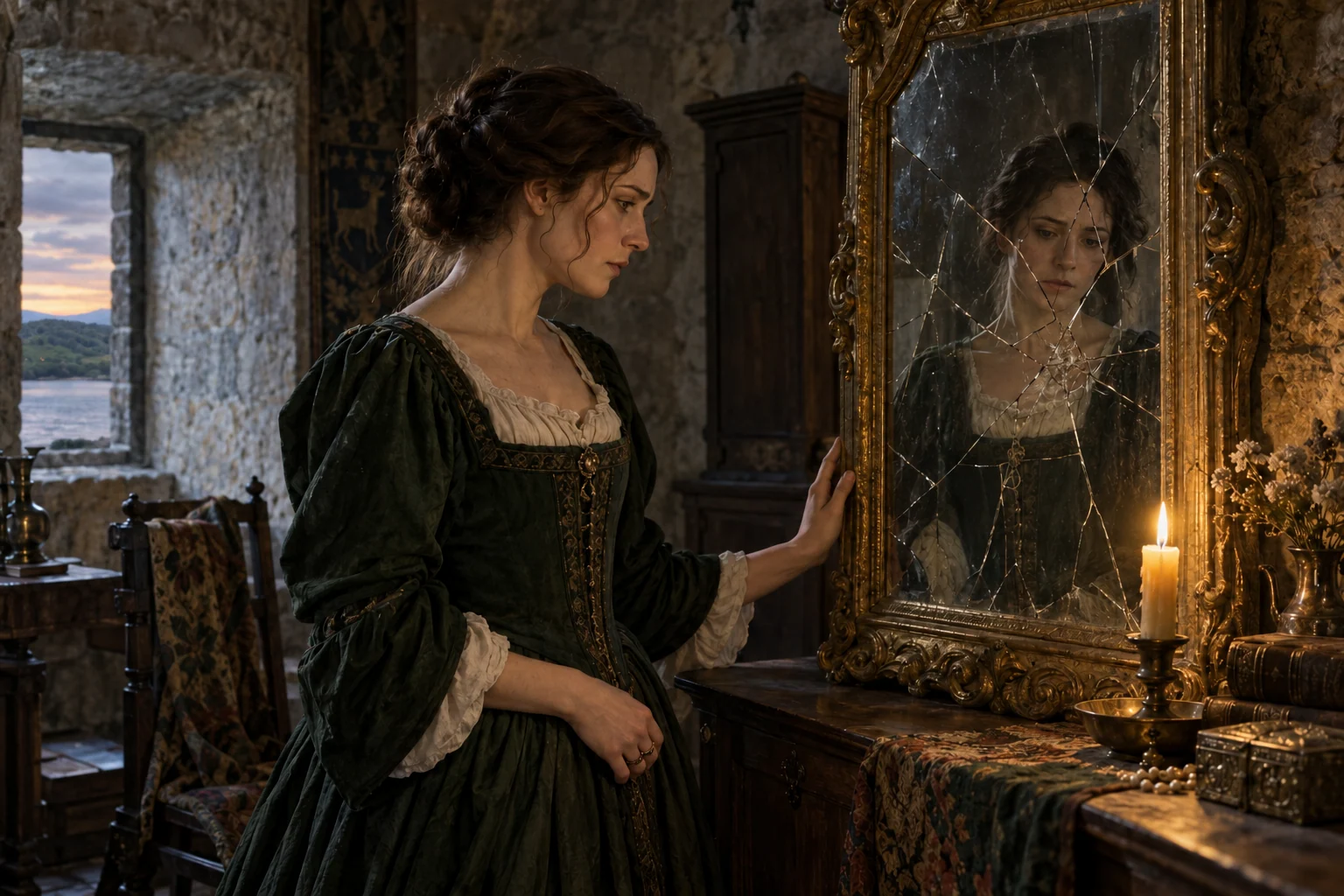
The story of “The Shattered Mirror” is this. In 1685, Lady Margaret Hodnett resided at Belvelly Castle. The Hodnett fortunes were at the time at their peak. The beauty of Lady Margaret was a legend, even as far as Holland, from whence came suitors, one of whom was no less a person than a stripling if the House of Orange. She played fast and loose with the lot of them. For as fabulous as was her beauty of face and figure, her mind was a “flutter-box,” to use an old Irish term. Shallow, capricious, wantonly unrestrained, she was wild as hawk, causing trouble wherever she appeared.
When she was rounding twenty-five, she caught the erstwhile roving eye of one Clon Rockenby of Castle Haro, which stood high above Bay of Kinsale. Rockenby was of a cadet branch of the rich and powerful Desmonds. Lady Margaret not only caught this stalwarts eye, she held it for years, to her final undoing. For a while she kept Rockenby dangling. Imperious to the hilt, she would send him packing every few months, in a fit of pique, only to recall him to post haste when she was bored. He always came running.
This slamming of doors had taken place in the late summer. Realizing that further entreaty was futile, Rockenby resolved on a plan, a plan very much in keeping with the era.
Clon Rockenby rode back to Castle Haro. Here he called his captains of men at arms together. In a few days, Clon , with two thousand men, set out for Castle Desmond, near Baltara. He knew that his uncle, head of the fighting Desmonds, would help him. He gave Clon a further thousand men. It was not to be open warfare, just a siege to starve this upstart Hodnett woman into submission. It irked Clon to think that, treacherous and foolish as he knew Margaret Hodnett to be, he loved her extravagantly. There it was.
Winter came down the valley of the Lee with harsh, wet winds. Cold gusts of sleet blew in from the sea. Even in County Cork, where winters are mild, cold from two quarters boded a bad winter.
The standing of the siege took all at Belvelly Castle by surprise. They had not even thought to lay in provisions for the winter. Hodnett still trusted to baggage trains coming in weekly from Cork. Clon deployed his men to harass these provision routes. He aimed to let just enough food filter through to keep alivethe family and garrison of a few hundred men at Belvelly, hoping by this method to reduce the strength of their arms to a negligible point and to break the will of Lady Margaret.
One year passed. The second winter set in soft as summer. Clon allowed no harvest to be reaped by Belvelly farmers, lest they try to smuggle in grain to their overlord at the castle. The plight within the walls of Belvelly was rapidly becoming desperate. Why Margaret’s father allowed this state of affairs to drag on, no one knows. Why he did not force her to accept Clon Rockenby and lift this shameful siege is a mystery. Every once in a while a small group of men from the castle garrison would wheel out on half starved horses and make a feeble sortie. Presently, after a few men were killed on both sides, they would gallop back under he portcullis. A few times Clon saw a wan, hungry looking Lady Margaret walking on the battlements. She made no sign she ever saw him.
The third winter of siege set in wild and bitterly cold. By this time Rockenby himself was mortally tired of this stagnant state of affairs. He called his captains and bade them completely cut all supply lines. Within a fortnight a white flag waved fitfully from a spear point in the grill above the portcullis.
Clon called two captains. They approached the silent tower. A dreadful sight met their eyes. Bodies of men starved to skeletons lay in oddly distorted heaps. The stench of unburied dead made them retch. Entering stealthily under the arched gateway, Clon found himself in the inner court. He came face to face with Lady Margaret. Her reddened eyes looked out at him from a great desolation. She was so weak from hunger she could scarcely stand. She leaned on the arm of an old serving women, who wept miserably. Lady Margaret stood with her back to the mirror, looking Clon full in the face. Pointing to her face she said, “Look-look what you have done.” Then she turned, slowly, until, reflected in the depths of the Venetian mirror at the foot of the stairs, was a pitiful, shivering woman, the mirror which for years had given back from its shadows the face of resplendently beautiful Lady Margaret.
As Clon watched, his voice perished in his throat. He could not speak to her. Great tears slid down her face and she swayed in weakness. Clon could stand this no longer. He grasped his sword by the end of its scabbard. With the heavy hilt he destroyed in one stroke the glass and its ghastly reflection.
Lady Margaret gave a piercing shriek. Flinging up her arms, she clutched the frame of the shattered mirror. It slipped from her grasp, and she sank to the floor in a dead faint. Turning swiftly, Clon made for his camp across the river, where he gave orders to lift the siege that night and send food to starving inmates of the tower.
On the battlements crouched a young brother of Lady Margaret. He had watched the scene in front of the mirror. After seeing his sister carried to an upper room and tended, he had rushed to the battlements, longbow across his shoulder. Carefully he fitted a bronze tipped arrow to the thong of his bow. Oiled deer hide thongs had strength and far reaching power. The bow took aim. The arrow, released from the bow, sped to its mark like death laden lightning. The dagger-like tip embedded in the cheek of Clon Rockenby, just as he was crossing the bridge.
By the time his men reached Clon’s side, he knew he was dying. The men lifted him in their arms and bore him to a tent. “Lift the siege-give them food,” Clon said. Then his head lolled, but suddenly he stiffened and murmured, “Margaret, I curse you. May you search for mirrors all your life, and never find.” Lying back in the arms of one of his captains, Clon Rockenby died, on the frozen siege-ground in front of Belvelly Castle.
It is said that Lady Margaret Hodnett only partially regained her beauty. After she recovered form the terrible effects of the long siege, her inordinate love of mirrors suffered an eclipse. At first she would not have mirrors anywhere around, probably remembering too well the frightful reflection of her face given back by the Venetian mirror the day it was shattered by Clon Rockenby. Later she had small mirrors and took them out by stealth. This was after her mind began to go. When her father died, Lady Margaret inherited Belvelly Castle. Suitors again claimed her. One learns she took lovers, but none of prominence or of lasting interest. She never married.
When her mind began to wander, it was in unaccountable ways, at first, such as attempting to dam up the River Lee, which is a public waterway. She flew into a rage when threatened with imprisonment and shut herself up, becoming a recluse. Soon her madness increased. She would wander through the rooms of Belvelly, rubbing spots on the wall. Leaning close, she would peer into these spots and preen herself as if in front of a mirror. She died in a barred room in the castle. The house passed to a distant kinsman. Later, after 1830, it was abandoned as living quarters, even by the tenant farmers who reclaimed it for a few years.
Those who have seen the ghost of Lady Margaret Hodnett disagree about her face. Some say a thick, white cloth or veil obscures it completely. Others say she has no face, only a sphere of pale luminous mist which floats, above her shoulders, where the face should be. All, however, say she walks slowly around the castle rooms, rubbing the stones with her forearm, then bending forward as if gazing intently into a mirror. Some of the large stones in the walls of the rooms of Belvelly Castle are rubbed much smoother than others. They gleam almost as if glazed with burnished enamel. If one stoops a bit, the reflection of one’s face appears, blurred slightly, as if reflected in water.