

Folklore · 7 minute read
Prelude
Preserved from the castle’s former website as a work of folklore. Dates, people and events in this story do not establish the documented chronology of Belvelly Castle.
One night in 1930 I drove along the road from Ballyvourney to Cork. A mile or more before one reaches the arched stone bridge which carries the highroad across the River Lee, the road runs through the thickly wooded demesne of Lord Barry-more. Emerging from the deep shadows of the overhanging trees, towering gateposts appear on the right-hand side of the road. These lichen-covered stone plinths are guarded by frighteningly realistic wild boars, crouching and defiant. The wild boar is the Barrymore device. Never have I seen the animal more startlingly displayed than in these two gray-marble carvings. Often one sees the armorial animal of a great house portrayed as an exaggerated, heraldic beast. Not so these boars; they seem to have sprung full-formed gnashing and savage, from the surrounding trees, instanter. These particular specimens are said to have been brought from Verona, where they were carved under the watchful eye of Lord Barrymore during one of his sojourns in Italy. The date on the figures is 1809. A much earlier boar, crudely carved in limestone was taken from the mud at the bottom of the River Lee at the foot of Belvelly Tower. This is the one which played so dramatic a part in the murder of Luccero Moreno, the Italo-Spanish troubadour whose lyric ghost, high in the tower of Belevlly Castle, makes midnight music on moonlight nights.
Children of the village, and they sent on errands, are fascinated by these fearsome beasts. They know them well; ride them as they would hobbyhorses, and mark them up in the brands of pink & purple chalk. For luck, I saluted the marble guardians as I passed-we say in Ireland, “Give the front of your hand to your neighbour’s gatepost, for you never know when you may wish to pass through it.”
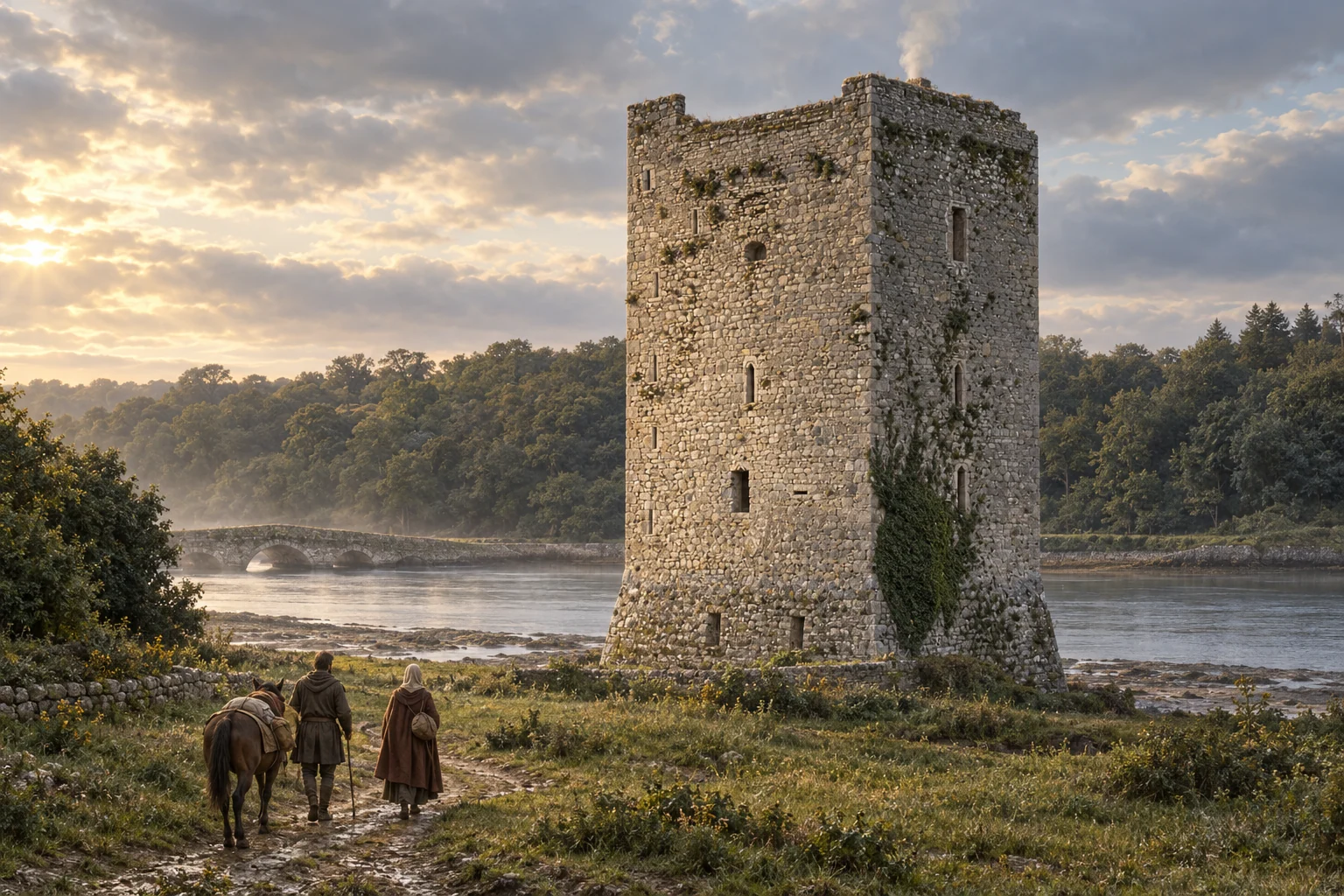
As my car mounted the brow of a hill, after leaving the shadows of the demesne, I saw the moon, which during most of my drive had hidden behind a black cloud bank, shining full & bright. A sharp white radiance bathed the night world. Objects the like of trees , gateposts, hedges, and towers stood out in exclamatory black. Below me spread the flat valley of the River Lee. Mirrored to its full height in the still, moon brushed water was the tower of Belvelly Castle. Ivid and lone, it seemed enormous , dominating the surrounding landscape even more dramatically at night than by day.
So still was the night that I heard soft voices somewhere, far up the river. A fox barked at the moon, and so sharp was the impact of the sound that it seemed like a pistol shot on the horizon. The tower of Belvelly cast a long finger of shadow across the lives of its owners, a Norman family called Hodnett.
So many stories are told of dark days and doings inside the walls of the castle that there is not room in this volume to relate to them all. I will tell two. One is the story called the “Duel with Song.” The duel was fought by the troubadour Luccero Moreno and a Gaelic bard called Dion the Thrush. It took place in the year 1200. The other story concerns a vain and troubled lady. Its called “The Shattered Mirror.”
Belvelly , like so many very early castles in Ireland, is a single tower. I once found an old book on a stall along the Liffey Quay in Dublin. It was a sort of family log, or diary, written in exceedingly minute script. For years the writer, a women named McIlligy, had jotted down every happening during her days. A good deal of the writing had been ruined by damp and mold and towards the middle of the book which was in better condition than the rest, there was one passage that interested me immensely. It concerned the beleaguered Hodnetts” (1685), as the women McIlligy describes them, and a siege which lasted three years, during which over half the people gathered in the tower of Belvelly starved.
An inordinately vain and flirtatious daughter of the Hodnett, occupying the castle at the time, caused a Clon Rockenby of Kinsale to fall madly in love with her. When she found he no longer interested her and sent him packing, he was not having it that way. Calling a great company of men-at-arms, he besieged Belvelly and all left alive in it, including the capricious lady, were nearly reduced, a boy standing at the top of the tower shot an arrow from a longbow. It struck Clon Rockenby in the cheek. He died cursing all within the tower; with an added extra curse for the Lady Margaret Hodnett. Whatever the other members of her family suffered is not related. For the rest of her life however, Margaret was persecuted by the curse. She at the last went mad.
The covering of this McIlligy log, apart from what writing I could decipher, makes the book unique. Bound in black horsehide, it is tied with braided leather thongs. A huge letter “M” is burned into the hide on both covers. The sign of Satan’s hoof is imprinted like a thumbmark in brown smudge (which may easily be blood) on the top corner of each parchment page. I asked an authority on such matters as the curious bindings of old books what he made of this device, the recurrence of the satanic hoof. Perplexed, he said, “It might be a personal monogram, a sign for the Black Mass, or, as was often done in the Middle Ages in Europe, an imprint used by someone who has avowed his soul to Satan and is proud of it.” The sight of Belvelly Castle kindled my interest all over again. I decided that next day while I was in Cork I would lunch with a man who could give me all the fine points and high lights of the curiously involved legends of that house.
The River was high that night. Almost a small, shallow lake spread over the meadows on three sides of the castle. As the Irish countryman says, “A small class of flood, to green the turf only.” Reluctant to leave the hushed beauty of this night, I walked over to sit for a while longer on the bridge coping. Sitting half in the shadow of the stone pillars at the end of the bridge were two young women. So still were they that I had not noticed them before. They sat motionless, each with her hands idling in her lap. One girl had thrown her shawl back from her shoulders, and, I noticed, she stared with rapt intensity away across the river to the window near the water gate of Belvelly, the room where Luccero Moreno is said to have been imprisoned. The bosom of the other women was covered by only a thin white bodice, and its rapid rise and fall denoted she was holding in the check of strong emotion. Both women were completely oblivious to me and, it seemed, to each other. I got into my car and headed for Cork, more determined than ever to find out what drew such silent devotion from the simple country people of Belvelly Village.
Next morning I telephoned Thomas Caley, who knows more than most other living men about hauntings, ghost-layings, and general “goings on,” as he describes them, of the world beyond the grave. He lunched with me at the excellent Victoria Hotel famous the world for its Charles II silver service and its Limerick Bacon omelettes. After regaling ourselves with a generous omelette apiece, we strolled to a bench on the Parade overlooking the River Lee. During the long, golden afternoon Thomas told me stories of “Duel with the Song” and “The Shattered Mirror.” So they’re at it again,” he said when I told him of the two girls waiting and listening on the bridge. “ Those bewitched women of Belvelly, streaking the roads at night, sitting till the dawn, waiting and hoping to hear the voice of murdered and long long dead Moreno. It’s strange the hold those siren songs have on men and women alike, though men won’t admit it, mostly. Myself heard them many’s the time, and me living as a boy and young man at Fillery, an old house, now burned, a few miles from Belvelly Castle. They are heard in the full of the moon only, and are becoming rarer and rarer.
Wish I had never heard them. They put a longing on you that is hard to conquer. I nearly ran away out of Ireland a number of times after I heard them. Many young women and girls have disappeared, gone clean away from the countryside, down the years. Two that I know of drowned themselves in the river at the foot of the tower.